d

Formulas


The formulas are what make a spreadsheet a spreadsheet. Excel allows you to introduce flexible used values ​​(or text) in cells to calculate the result. When you enter a formula in a cell, the result of the formula appears in the cell. If you change any of the cells used by a formula, the formula recalculates and displays the new result.
Formulas can be simple mathematical expressions, or can use some powerful functions that are built into Excel. In Picture shows an Excel spreadsheet set up to calculate the monthly loan payment. The worksheet contains the values, text and formulas. The cells in column B contain text. Column C contains four values ​​and two formulas. The formulas are in cells C7 and 11. Column E, as a reference, shows the actual content of the cells in column C.

Formulas
raj-excel.blogspot.com


Function


A prewritten formula that takes a value or values, performs an operation, and returns a value or values. Use functions to simplify and shorten formulas on a worksheet, especially those that perform lengthy or complex calculations.

Spreadsheet


spreadsheet is an interactive computer application program for organization and analysis of data in tabular form. Spreadsheets developed as computerized simulations of paper accounting worksheets. The program operates on data represented as cells of an array, organized in rows and columns. Each cell of the array is a model–view–controller element that can contain either numeric or text data, or the results of formulas that automatically calculate and display a value based on the contents of other cells.
The user of the spreadsheet can make changes in any stored value and observe the effects on calculated values. This makes the spreadsheet useful for "what-if" analysis since many cases can be rapidly investigated without tedious manual recalculation. Modern spreadsheet software can have multiple interacting sheets, and can display data either as text and numerals, or in graphical form.
In addition to the fundamental operations of arithmetic and mathematical functions, modern spreadsheets provide built-in functions for common financial and statistical operations. Such calculations as net present value or standard deviation can be applied to tabular data with a pre-programmed function in a formula. Spreadsheet programs also provide conditional expressions, functions to convert between text and numbers, and functions that operate on strings of text.
Spreadsheets have now replaced paper-based systems throughout the business world. Although they were first developed for accounting or bookkeeping tasks, they now are used extensively in any context where tabular lists are built, sorted, and shared.
Visicalc was the first electronic spreadsheet on a microcomputer, and it helped turn the Apple II computer into a popular and widely used system. Lotus 1-2-3 was the leading spreadsheet when DOS was the dominant operating system. Excel now has the largest market share on the Windows and Macintosh platforms. A spreadsheet program is a standard feature of an office productivity suite; since the advent of web apps, office suites now also exist in web app form.


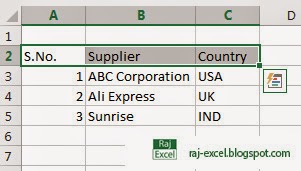
How to make text or data Bold in Excel 2013


 First select your text/data you need to bold

How to make text or data Bold in Excel 2013
raj-excel.blogspot.com


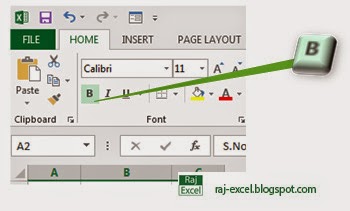
Go to Home Tab>
In the Font group click the Bold icon look like this (for example see the picture below)

Or
Keyboard short: Hit the or  

How to make text or data Bold in Excel 2013
raj-excel.blogspot.com


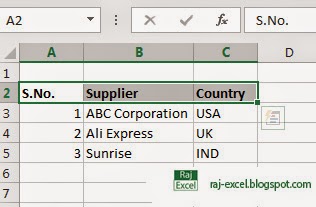
and you will see the all the selected text convert to normal font to bold. (for example see the picture below)

How to make text or data Bold in Excel 2013
raj-excel.blogspot.com


Italic


Italic Justification:

In typography, italic type is a cursive typeface based on a stylized form of calligraphic handwriting. Owing to the influence from calligraphy, such typefaces often slant slightly to the right. Different glyph shapes from roman type are also usually used—another influence from calligraphy. True italics are therefore distinct from oblique type, in which the font is merely distorted into a slanted orientation. However, uppercase letters are often oblique type or swash capitals rather than true italics.
This style is called "italic" for historical reasons. Calligraphic typefaces started to be designed in Italy, for chancery purposes. Ludovico Arrighi and Aldus Manutius (both between the 15th and 16th centuries) were the main type designers involved in this process at the time.

"Italics are the print equivalent of underlining" and typewriter users underlined words that would normally appear as italics in professionally printed works. source

Number


A number is a mathematical object used to count, label, and measure. In mathematics, the definition of number has been extended over the years to include such numbers as 0, negative numbers, rational numbers, irrational numbers, and complex numbers.
Mathematical operations are certain procedures that take one or more numbers as input and produce a number as output. Unary operations take a single input number and produce a single output number. For example, the successor operation adds 1 to an integer, thus the successor of 4 is 5. Binary operations take two input numbers and produce a single output number. Examples of binary operations include addition, subtraction, multiplication, division, and exponentiation. The study of numerical operations is called arithmetic.
A notational symbol that represents a number is called a numeral. In addition to their use in counting and measuring, numerals are often used for labels (telephone numbers), for ordering (serial numbers), and for codes (e.g., ISBNs).

In common usage, the word number can mean the abstract object, the symbol, or the word for the number. Source

Data


For data in computer science, see Data (computing). For other uses, see Data (disambiguation).
Data (/ˈdeɪtə/ day-tə, /ˈdætə/ da-tə, or /ˈdɑːtə/ dah-tə) are values of qualitative or quantitative variables, belonging to a set of items. Data in computing (or data processing) are represented in a structure, often tabular (represented by rows and columns), a tree (a set of nodes with parent-children relationship) or a graph structure (a set of interconnected nodes). Data are typically the results of measurements and can be visualised using graphs or images. Data as an abstract concept can be viewed as the lowest level of abstraction from which information and then knowledge are derived. Raw data, i.e., unprocessed data, refers to a collection of numbers, characters and is a relative term; data processing commonly occurs by stages, and the "processed data" from one stage may be considered the "raw data" of the next. Field data refers to raw data collected in an uncontrolled in situ environment. Experimental data refers to data generated within the context of a scientific investigation by observation and recording.
The word data is the plural of datum, neuter past participle of the Latin dare, "to give", hence "something given". In discussions of problems in geometry, mathematics, engineering, and so on, the terms givens and data are used interchangeably. Such usage is the origin of data as a concept in computer science or data processing: data are numbers, words, images, etc., accepted as they stand.
Though data is also increasingly used in humanities (particularly in the growing digital humanities), it has been suggested that the highly interpretive nature of humanities might be at odds with the ethos of data as "given". Peter Checkland introduced the term capta (from the Latin capere, “to take”) to distinguish between an immense number of possible data and a sub-set of them, to which attention is oriented.[1] Johanna Drucker has argued that since the humanities affirm knowledge production as “situated, partial, and constitutive,” using data may introduce assumptions that are counterproductive, for example that phenomena are discreet or are observer-independent.[2] The term capta, which emphasizes the act of observation as constitutive, is offered as an alternative todata for visual representations in the humanities.


Font


"Fount" redirects here. For the original meaning, see fountain.
This article is about the traditional meaning of "font". For the electronic data file, see Computer font. For other uses, see Font (disambiguation).
Font nowadays is frequently used synonymously with the term "typeface", although before the advent of digital typography and desktop publishing, "font" referred to a single size and "typeface" referred to a set of otherwise identical fonts of different sizes.
Beginning in the 1980s, with the introduction of computer fonts, a broader definition for the term "font" evolved. Different sizes of a single style separate fonts in metal type are now generated from a single computer font, because vector shapes can be scaled freely. "Bulmer", the typeface, may include the fonts "Bulmer roman", "Bulmer italic", "Bulmer bold" and "Bulmer extended", but there is no separate font for "9-point Bulmer italic" as opposed to "10-point Bulmer italic". source

Text


In literary theory, a text is any object that can be "read," whether this object is a work of literature, a street sign, an arrangement of buildings on a city block, or styles of clothing. It is a coherent set of signs that transmits some kind of informative message. This set of symbols is considered in terms of the informative message's content, rather than in terms of its physical form or the medium in which it is represented.
Within the field of literary criticism, "text" also refers to the original information content of a particular piece of writing; that is, the "text" of a work is that primal symbolic arrangement of letters as originally composed, apart from later alterations, deterioration, commentary, translations, paratext, etc. Therefore, when literary criticism is concerned with the determination of a "text," it is concerned with the distinguishing of the original information content from whatever has been added to or subtracted from that content as it appears in a given textual document (that is, a physical representation of text).
Since the history of writing predates the concept of the "text", most texts were not written with this concept in mind. Most written works fall within a narrow range of the types described by text theory. The concept of "text" becomes relevant if/when a "coherent written message is completed and needs to be referred to independently of the circumstances in which it was created."


Bold


Bold Justification:

The human eye is very receptive to differences in brightness within a body of text. Therefore, you can differentiate between types of emphasis depending on whether the emphasis changes the "darkness" of text.

By contrast, the weight makes text bold darker than the surrounding text. With this technique, the highlighted text is strongly out from the rest, so it should be used to highlight certain keywords that are relevant to the topic of the text for easy visual scanning text. For example, printed dictionaries often use boldface for their keywords, and the names of the inputs can be conventionally marked in bold.


Why use;
The most common methods in Western typography fall under the general technique of care through a change or modification of the font:

for see the example how to apply click here

Recommended for You

LinkWithin

Related Posts Plugin for WordPress, Blogger...